

Apartment CCTV Rules in Australia: What You Can Install

There is no single national rulebook for apartment CCTV in Australia. Three layers apply at once: state or territory surveillance laws, your strata by-laws or lease, and plain privacy and nuisance principles. In short, you can generally film the inside of your own apartment. You can't film bathrooms or other people's private spaces, and you can't record conversations you aren't part of. Anything fixed to common property needs the owners corporation on side first.
We install and design camera systems across NSW, so this guide leans on NSW, with notes where other states differ. It is general information, not legal advice. If a dispute is already heated, speak to a lawyer or a community legal centre before you act.
Key takeaways
- Cameras inside your own apartment are generally lawful, but never in bathrooms, toilets or change areas, and never aimed into someone else's home.
- Recording audio is where people get caught. In NSW, recording audio without consent is an offence, so turn audio off.
- Fixing a camera to common property (the hallway wall, a balcony face, the building exterior) usually needs owners corporation approval, often through a by-law.
- Tenants should get written landlord permission before installing anything, and landlords shouldn't film inside a rented home.
- If a neighbour's camera bothers you, start with a calm conversation, then follow up in writing before escalating.
Table of Contents
- Why apartments are different from houses
- The three layers of rules
- Cameras inside your own apartment
- Balconies, doorways and common property
- If you rent
- What can a neighbour film?
- If a camera is invading your privacy
- Planning a camera setup that stays compliant
- Where we can help
- Our perspective
- FAQ
- Sources
Why apartments are different from houses
In a house, the boundary is simple. In an apartment, your lot, the common property and your neighbours' lots sit within a metre or two of each other. A camera at your front door can capture the corridor, the lift lobby and your neighbour's doorway in one frame.
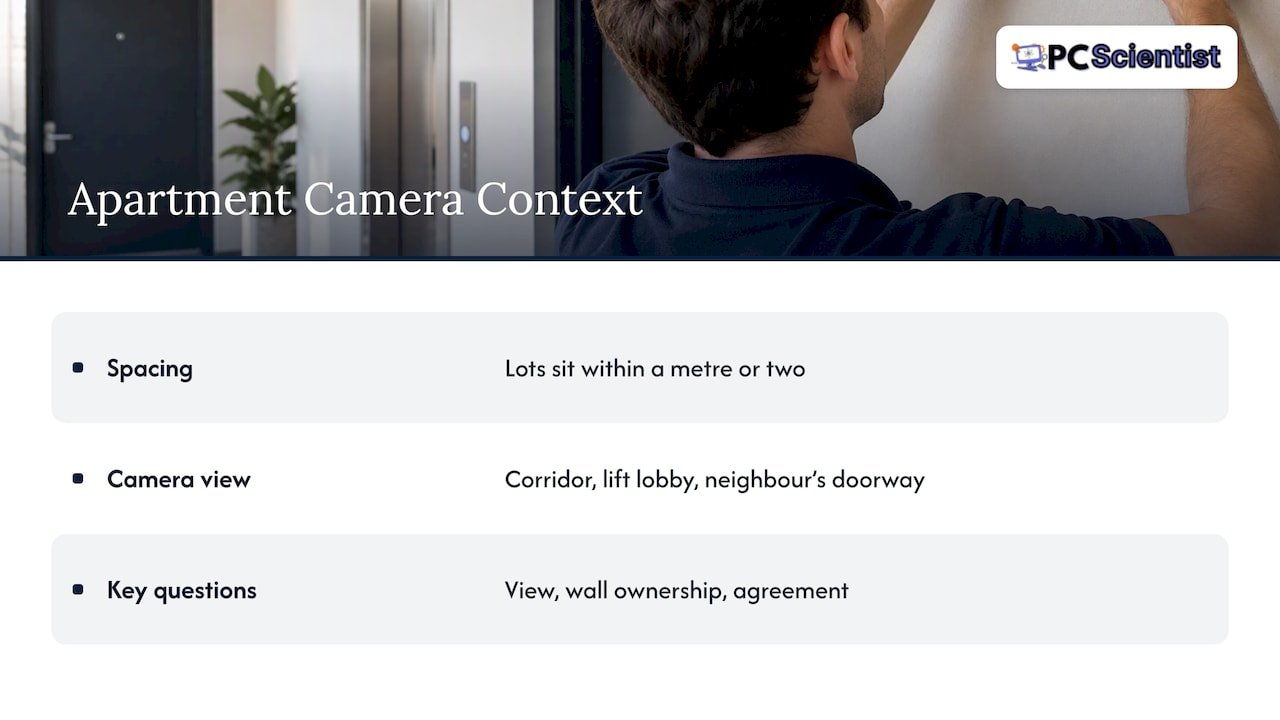
That is why a camera that is perfectly ordinary on a freestanding home can become a dispute in a building. The question is rarely "is CCTV legal?". It is "what does this camera see, who owns the wall it is fixed to, and who agreed to it?"
The Office of the Australian Information Commissioner (OAIC) explains that the federal Privacy Act covers government agencies and organisations with an annual turnover of more than $3 million, but not a security camera run by an individual in a private capacity. For most apartment owners and tenants, that means state or territory laws, by-laws and council rules do the real work.
The three layers of rules
| Layer | What it covers | Who enforces it |
|---|---|---|
| State or territory surveillance law | Filming private activities, recording conversations, sharing footage | Police and courts |
| Strata by-laws, body corporate rules or lease terms | Where cameras can be fixed, who approves them, how footage is handled | Owners corporation or body corporate, tribunals |
| Privacy, nuisance and council rules | Cameras that harass, intimidate or interfere with a neighbour's enjoyment of their home | Councils, courts, mediation services |
A camera can be lawful under the first layer and still breach the second. Check all three before you buy anything.
Cameras inside your own apartment
If you own or rent your apartment, a camera that records only the inside of your own home is generally the least contentious option. A few firm limits apply.
Private areas are off limits
Never place a camera where it could capture a bathroom, toilet, shower or bedroom of anyone who hasn't agreed. In NSW, surveillance without consent of places where a person could reasonably expect privacy, such as a bedroom or bathroom, is an offence when done for sexual arousal or gratification, with a maximum penalty of an $11,000 fine or two years in prison, and higher penalties where children are involved.
Queensland is stricter in wording. Filming someone without consent in a private place, or during a private act where they would reasonably expect privacy, is a criminal offence. The examples given include using a toilet, showering, bathing or being intimate.
The practical rule is the same everywhere: if you wouldn't be comfortable explaining the camera's field of view to a police officer or a tribunal, move it.
Visitors, cleaners and housemates
The law may be only part of the issue. A guest, a cleaner or a flatmate who finds a camera in a living area will reasonably feel watched. Tell people. If someone lives with you, agree on where cameras go. Hidden cameras inside a home are the fastest route to a police complaint.
Audio: turn it off
Many consumer cameras record sound by default. In NSW, recording audio without consent is an offence under section 7 of the Surveillance Devices Act 2007, and that offence does not extend to recording images. In an apartment, thin walls and shared corridors make it easy for a microphone to pick up other people's private conversations.
Other states are similar in spirit but differ in detail:
- Queensland: a person must not record a private conversation they are not involved in. If CCTV is likely to capture one, the audio should be disabled and the camera positioned so a conversation can't be lip-read.
- South Australia: the Surveillance Devices Act 2016 generally prohibits recording a private conversation or private activity without the consent of all principal parties, with exceptions. Maximum penalties are $15,000 or three years' imprisonment for an individual.
- Participant recording: a NSW Government paper notes that Queensland, Victoria and the Northern Territory have participant-monitoring exceptions and the other jurisdictions do not. That is why you shouldn't assume what is fine in one state is fine in another.
The safe default for any apartment: video only, audio disabled.
Balconies, doorways and common property
This is where most apartment disputes start.
Who owns what
In NSW strata, the owners corporation is responsible for common property. The NSW Government's strata repairs guidance lists balconies and balcony doors among those responsibilities. So even when a balcony feels like part of your home, drilling into its face or fixing a bracket to the building structure may not be yours to decide alone.
Approval depends on the mounting point
NSW strata law has no dedicated CCTV chapter, so the answer comes down to what you touch. Bannermans Lawyers explains that a useful camera mounted on a common-property wall will likely need owners corporation approval and a common-property-rights by-law passed by special resolution. A camera inside the lot on a stand, powered from a power point or battery and not altering common property, could in theory go up without approval, though its view may be limited.
In plain terms:
- Freestanding inside your lot, looking at your own space: usually no approval, but still no private areas and no audio.
- Fixed to common property (corridor wall, balcony exterior, door frame in some schemes): get approval first, usually through a by-law.
- Pointing at common areas or other lots: high risk. This is the category that triggers complaints.
The same firm adds that lot owners shouldn't install cameras in a way that creates an undue invasion of privacy or nuisance, or that views toilets, changing rooms or the interior of other lots. NSW strata law also prohibits nuisance and unreasonable interference with others' use of common property.
Smart doorbells
A video doorbell sits in the grey zone because its lens often faces the corridor. If it is screwed to the door, the question is whether the door is yours or common property in your scheme, and what the lens captures. Check your by-laws, and ask your strata manager before you drill. If you can narrow the field of view or use a privacy zone so it only covers your own doorstep, you reduce the risk of a complaint.

Cameras the building installs
Owners corporations can install their own CCTV in lobbies, car parks and lifts. Queensland guidance is a helpful benchmark for any state: a body corporate that sets up CCTV on common property must operate it reasonably and comply with legislative requirements. Cameras should maximise coverage of entrances, exits and target areas, and should not be placed to spy on residents or guests.
In NSW we'd recommend any scheme pass a clear by-law covering who can view footage, how long it is kept, who maintains it and how residents can raise concerns. Our NSW CCTV laws guide covers notice and compliance for installs in more detail.
If you rent
Tenants and landlords each have limits.
Tenants should assume they need the landlord's written permission before fixing anything to walls, doors or frames, and should check the lease. Rules vary by state. In Western Australia, for example, a tenant can install security alarms and cameras to prevent family violence without approval, but must notify the landlord in writing beforehand, use a suitable tradesperson and provide the invoice within 14 days. That is a specific protection, not a general right, so check your own state's tenancy regulator.
If your landlord won't agree, battery cameras and renter-friendly adhesive mounts inside your home may avoid damage. They still have to respect the rules above on private areas and audio.
Landlords can generally put cameras in shared or outdoor areas to protect the property, but not inside a tenant's home. A tenant who finds a camera pointing at their living space can raise it with the landlord or agent first, then with their state's tenancy tribunal, which in NSW is NCAT.
What can a neighbour film?
People often search this because a neighbour's camera seems to look straight at their balcony or window.
NSW Legal Aid says a person can generally put a camera on their property, but should think about whether it points at someone else's property and interferes with their privacy, worsens a dispute, makes a neighbour feel threatened or harassed, or records footage that may not be usable in court.
There is no general right to privacy in Australian law. Law professor Barbara McDonald told the ABC that federal and state laws give some protection with gaps, and that surveillance may amount to private nuisance if it restricts a neighbour's use and enjoyment of their land.
What does that mean for you?
- A camera that only covers its owner's own space is usually fine.
- A camera aimed at your window, balcony or bedroom is different, and may be unlawful depending on what it captures and why.
- Footage used for indecent purposes is a police matter.
If a camera is invading your privacy
Work through these steps in order. Most disputes end at step one or two.
- Talk to them. Be polite and specific: "Your camera seems to cover my balcony door. Could it be angled down?" Legal Aid NSW suggests speaking to the neighbour or considering mediation first.
- Follow up in writing. Professor McDonald recommends asking politely, then following up in writing and keeping a copy.
- Check your by-laws. If the camera is fixed to common property, tell the strata manager or committee. They can ask whether it was approved.
- Try mediation. The NSW Information and Privacy Commission points to mediation and the local council's rules, and says footage being used for indecent purposes can be reported to police.
- Escalate carefully. If it remains unresolved, options include the council, police, a community legal centre or, as a last resort, an injunction. For safety concerns, contact police straight away.
If you're the one installing, you avoid all of this by being open: tell neighbours what the camera covers and show them the view.
Planning a camera setup that stays compliant
A good installation is mostly about decisions made before anyone picks up a drill.
- Define the purpose. Entry door, parcel theft, car space, or a pet at home? Each leads to a different camera position.
- Map the view. Stand where the camera will sit and check what falls inside the frame. Use privacy masking for anything that shouldn't be recorded.
- Check the mounting point. Your lot, or common property? If it is common property, you need approval.
- Switch audio off unless you've confirmed it is lawful and consented to.
- Control the footage. Strong passwords, two-step sign-in, and a clear idea of who can view and share recordings.
- Tell people. Visible, honest notice goes a long way with neighbours and visitors.
Our security camera placement guide walks through where each camera should go and what it will actually see.
Where we can help
If you're unsure what's allowed in your building, or you want a system that won't cause friction with neighbours, our Security Camera Scientist team can assess your site, explain what will and won't work, and install onsite across NSW. We'll look at mounting points, fields of view, camera types and how footage is stored and accessed. If you're a landlord or strata committee, we can also talk through a sensible approach before you write a by-law. You don't need to know the technical terms, just describe what you're worried about.
Our perspective
Most apartment CCTV problems we see aren't caused by the technology. They come from a camera put up in a hurry, aimed at the doorway because that's where the parcels go, with a microphone on by default and no one told.
We think the best apartment system is the least dramatic one. It covers your own door or space, uses video only, is fixed where you have the right to fix it, and is something you could happily explain to the neighbour across the hall. If a camera needs a by-law, we'd rather you wait for the approval than argue about it later. If a camera would make someone feel watched in their own home, we'd rather move it than find out how a tribunal sees it.
We also keep privacy and security in mind with the footage itself. A camera that anyone can log into is a bigger risk than the thing it was bought to protect.
- PC Scientist
Sources
- Security cameras, OAIC
- Noise, smells, developments and surveillance FAQs, Legal Aid NSW
- Entry, access and privacy, State Library of NSW
- BCCM Fact Sheet: Video, Queensland Government
- Recording private conversations or activities, Law Handbook SA
- Public interest exceptions consultation paper, NSW Government
- Strata repairs and maintenance, NSW Government
- CCTV FAQ: approvals for a lot owner, Bannermans Lawyers
- Making changes to a rental home, Consumer Protection WA
- Are your neighbours allowed to use surveillance cameras?, ABC News
- CCTV on private property, Information and Privacy Commission NSW
Recommended
- Avoid fines: CCTV laws in NSW, 14 days' notice and $120 site survey
- Australia CCTV Prewire: Conduit, ACMA Rules, $120 Survey
- Sydney CCTV installation costs: NSW licence rules and $120 site survey example
- CCTV Storage Options for Australian Homes and SMEs: Retention First
Frequently Asked Questions
Straight answers about Apartment CCTV Rules in Australia: What You Can Install - without jargon or pressure. Call 0493 563 381 for advice, or get help below.
Want the quickest answer? 0493 563 381 for free advice.
No. Recording in a bathroom, toilet or similar private area without consent can be a criminal offence in every state, and in NSW the penalties include up to two years in prison where it is done for sexual arousal or gratification. Keep cameras out of any space where someone would reasonably expect privacy.
It depends on what the camera captures and how it is used. The OAIC says the Privacy Act generally doesn't cover individuals acting privately, so state laws, strata by-laws and council rules matter. Start with a conversation, then put your concern in writing.
If you're fixing it to common property, usually yes, and in NSW that may mean a by-law. A camera that sits wholly inside your lot without altering common property is a different situation, but check your by-laws first. Your strata manager can tell you what your scheme requires.
Treat audio as off limits. In NSW, recording audio without consent is an offence, and other states have similar rules on private conversations. Disable the microphone in your camera settings.
A landlord can generally install cameras in shared or outdoor areas, but not inside a tenant's home. Tenants who find one pointing at their living space can raise it with the landlord or agent, then their state's tenancy tribunal.
CCTV help across NSW
Still stuck with apartment CCTV rules?
If you would rather not plan cameras on your own, get help in your area. We will talk it through first.
Start here
Get CCTV help
Optional Need a Sydney city or region?
Choose a side of Sydney
These are Sydney cities and regions, such as the Northern Beaches or Inner West. First tap a side of Sydney. Then open the city or region that covers you.
C Sydney City / Inner 3 areas
N Northern Sydney 5 areas
NW North-West / Central Sydney 3 areas
W Western Sydney 1 area
SW South-West Sydney 3 areas
S Southern Sydney 2 areas
Optional Find your suburb
Type a suburb from our listed coverage. This opens the matching city or region page for this topic. Listed suburb pages are general technology services, not this specialist page.
If your suburb is not listed, use the city or region list above, or call 0493 563 381.
Disclaimer
The information in this article is provided for general educational and informational purposes only. While PC Scientist strives to keep all content accurate and up to date, technology issues can vary depending on your device, software, network configuration, and individual circumstances. Always back up important data before attempting repairs or system changes. If you are unsure or the issue cannot be resolved safely, contact PC Scientist today for professional onsite or remote IT support. PC Scientist is not liable for any loss of data, damage, or other issues resulting from the use of the information provided in this article.